Planning to climb Mount Kilimanjaro? Start with the basics. These Mount Kilimanjaro facts cover how the mountain was formed, how high it is, what the weather does, which routes you can take and a few odd records set on its slopes. If you have questions, the answers are probably further down this page.
Kilimanjaro is different from most big mountains. It is very high, it stands on its own, and you can walk to the top without ropes. Getting there has also become easier. There are many operators now, from budget to luxury, so you can find a Kilimanjaro climb that fits your money and your plans.
Mount Kilimanjaro: Africa’s Highest Peak
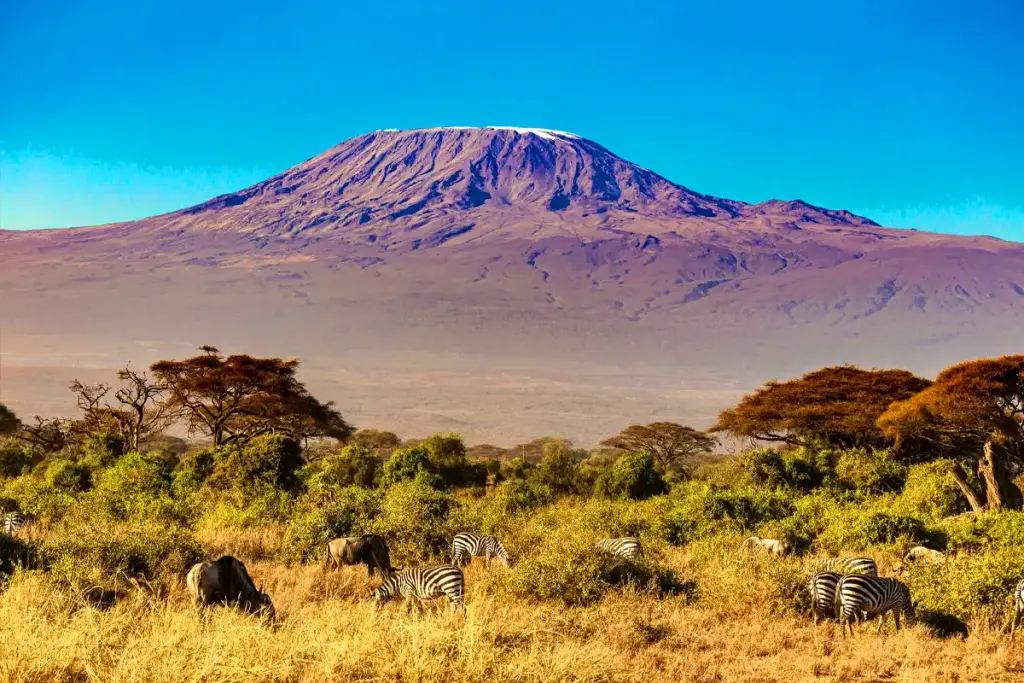
Mount Kilimanjaro is the highest peak in Africa and the tallest free-standing mountain in the world. That one fact is why so many people come to climb it.
What makes it different: Most high peaks sit in long mountain ranges. Kilimanjaro rises alone from the plains, and its height is the main draw for climbers from all over the world.
Getting there and choosing a trip: Climbing Mount Kilimanjaro is easier to arrange than it used to be. Hundreds of tour operators now run climbs for every budget and style, so planning the trip is simpler than ever.
Interesting Mount Kilimanjaro facts: The mountain has several climate and weather zones, which is one of the most interesting things about it. The sad part is the ice. The snow caps have lost nearly 80% of their mass since 1912, and scientists say Kilimanjaro could be ice-free within the next 20 years if this carries on.
Our research: We have pulled together the facts below to help you plan. Read them before you book and you will know what you are getting into.
Geography and Altitude:
Mount Kilimanjaro is in Tanzania’s northern circuit, inside Kilimanjaro National Park. It is a dormant volcano made of three volcanic cones: Shira, Kibo and Mawenzi. The last major eruption was about 360,000 years ago. The most recent volcanic activity was 200 years ago and left an ash pit on the mountain.
The summit, Uhuru Peak, is 5,895 meters (19,341 feet) above sea level, and on a clear day you can see a long way from the top. Mount Everest is still much higher, by 2,950 meters.
Here is a fact people like: both the south and north base camps of Mount Everest are lower than the summit of Kilimanjaro.
Because it is the highest peak in Africa, Mount Kilimanjaro is one of the Seven Summits, and climbers come from around the world to tick it off.
Weather and Climate Zones:
Two things shape the weather on Mount Kilimanjaro: the trade winds and the shape of the mountain itself. Together they create clear climate zones.
In March, the southeast trade winds bring moist air from the Indian Ocean. When that air hits Kilimanjaro it rises, clouds form, and it rains most days.
From April to October, the anti-trade winds from the northeast take over. They are dry and gusty and push back the southeast trade winds, so there is little cloud or rain.
In November the northeastern monsoon arrives and brings short spells of rain to the northern slopes of Kilimanjaro.
The wettest months are March, April and November. The best trekking conditions are usually from January to early March. From December to May you may get snow and cold temperatures.
On the way up Mount Kilimanjaro you pass through five ecological zones: Cultivated, Rainforest, Heath and Moorland, Alpine Desert and Arctic Summit. Each one has its own plants and animals.
Kilimanjaro Climbing Routes:
You can choose from 7 Kilimanjaro Routes, such as the Machame Route, Marangu Route, Lemosho Route, Northern Circuit Route, Rongai Route, Shira Route and Umbwe Route. All of them have good scenery and wide views, which is part of the fun. The 3 routes approach from the South, 3 from the west, and Rongai comes in from the North. For help picking the right route for you, read our Climb Kilimanjaro Guide.
People call the Machame Route the whiskey route, because it is a bit harder than the Marangu route, which is known as the coca cola route. The Lemosho route has the highest success rate at 95%, and the Northern circuit route also has a 95% success rate. That is why Lemosho and the Northern circuit are often named the Best Route to Climb Kilimanjaro if reaching the summit is what matters most.
| Northern Circuit | Lemosho | Machame | Rongai | Marangu | |
| Days | 9 | 6-8 | 6-7 | 6-7 | 5-6 |
| Distance (miles) | 60 | 42 | 38 | 45 | 43 |
| Difficulty/steepness | moderate | moderate | moderate | easier | easier |
| Lodging | camping | camping | camping | camping | dorm/hut |
| Crowds | very low | medium | high | low | high |
| Scenery | excellent | excellent | excellent | very good | good |
| Acclimitization | best | excellent | very good | fair | poor |
| Cost | high | medium – high | medium | medium | low |
| Success Rate | highest | high | medium – high | medium | lowest |
Kilimanjaro Summit Success Rate:
The success rate of summiting Kilimanjaro depends on a few things, mainly how many days you take and which route you choose. You do not need technical climbing skills on Mount Kilimanjaro, so many more people can try it than on other high peaks. Altitude is the real challenge. Resting at lower elevations and giving yourself enough time on the mountain are what help your body cope higher up.
Your route makes a big difference. Each Kilimanjaro route climbs at a different pace, and that changes your chances of reaching the summit. The rule to remember is simple: climb high in the day and sleep lower at night, so your body can adjust step by step.
Here are typical summit success rates by the length of the Kilimanjaro route:
- 5-Day Route: Success rate of 60% – 70%
- 6-Day Route: Success rate of 65% – 70%
- 7-Day Route: Success rate of 75% – 80%
- 8-Day Route: Success rate of 80% – 85%
- 9-Day Route: Success rate of 85% – 95%
- 10-Day Route: Success rate of 90% – 97%
Pick a route that gives your body time to adjust and your odds of summiting Kilimanjaro go up. Every extra day on the mountain helps you acclimatize and lowers your altitude-related risks.
The Highest Mountain In Africa
Mount Kilimanjaro is Africa’s tallest peak and the world’s tallest freestanding mountain, which puts it on the list of Seven Summits. It is the one summit on that list you can reach without technical skills or kit such as ropes, harnesses or crampons. Here are all Seven Summits:
- Mount Everest – Asia – First ascent in 1953 – At 8,848 meters, Everest is the highest peak on Earth.
- Aconcagua – South America – First ascent in 1897 – At 6,961 meters, Aconcagua is the highest peak in South America and the second highest of the Seven Summits.
- Denali – North America – First ascent in 1913 – Denali, also called Mount McKinley, is 6,194 meters high and the highest peak in North America.
- Mount Kilimanjaro – Africa – First ascent in 1889 – At 5,895 meters, Kilimanjaro is Africa’s tallest peak and the world’s highest freestanding mountain.
- Mount Elbrus – Europe – First ascent in 1874 – At 5,642 meters, Mount Elbrus is the highest peak in Europe.
- Mount Vinson – Antarctica – First ascent in 1966 – Mount Vinson, at 4,892 meters, is the highest peak in Antarctica.
- Mount Kosciuszko – Australia – First ascent in 1840 – At 2,228 meters, Mount Kosciuszko is the highest peak in Australia.
More Mount Kilimanjaro Facts: Where the Name Comes From
Nobody is quite sure where the name “Kilimanjaro” comes from. One idea is that it joins the Swahili words “Kilima”, meaning mountain, and “Njaro”, meaning whiteness, probably a nod to the snowy cap. The Germans, who called the snow-capped peak “Kilimanjaro”, believed the Swahili people on the coast called it “Mountain of Greatness” or “Mountain of Caravans”.
There is also a local story that the name comes from a KiChagga phrase meaning “we failed to climb it”, which says a lot about how hard the mountain looked to people living below it.
Speed Records and Other Feats:
In 2014, Swiss athlete Karl Egloff set the record for the fastest ascent and descent of Kilimanjaro: 6 hours and 42 minutes, up and down. He could only do it because he was well acclimatized and trained at high altitude.
Unusual Sporting Events:
Kilimanjaro has seen some odd sporting events. In September 2014 it hosted the highest cricket match ever played. Thirty cricket fans climbed to the summit, came back down to the crater camp and played a full game there, setting a new record.
The Highest Pizza:
In May 2016, Pizza Hut delivered a pizza to the summit of Kilimanjaro. It went into the Guinness World Records as the highest pizza delivery. It was a stunt, but a fun one.
Africa’s Tallest Tree:
Africa’s tallest tree grows on Kilimanjaro’s slopes. It is an Entandrophragma excelsum, 81.5 meters tall and thought to be about 600 years old. It shows how much plant life the lower mountain supports.
Golf at Altitude:
Nobody has a clear claim to the longest golf shot on Kilimanjaro. Still, a few golfers have tried teeing off from Uhuru Peak towards the crater rim, just to say they hit a ball at that height.
These stories and records are part of what makes Kilimanjaro such a popular mountain for climbers and curious travellers.
Kilimanjaro Climbing FAQs
Here are answers to the questions we hear most often about a Kilimanjaro climb:
How high is Mount Kilimanjaro?
Mount Kilimanjaro is 5,895 meters (19,341 feet) above sea level. That makes it the highest peak in Africa.
What is the best time to climb Kilimanjaro?
Go in the dry seasons, from January to March and from June to October. You usually get clearer skies and steadier weather in those months.
How long does it take to climb Kilimanjaro?
It depends on your route, but most climbs take 5 to 9 days. More days give your body time to acclimatize, and that raises your chance of reaching the summit.
Do I need to be an experienced climber to climb Kilimanjaro?
No. You do not need any climbing experience. You do need to be reasonably fit and ready for some hard days. Plenty of first-timers reach the summit with good guides and some training at home.
What is altitude sickness, and how can I prevent it?
Altitude sickness, or acute mountain sickness (AMS), happens when your body cannot adjust to the lower oxygen levels high up. To lower the risk, climb slowly, drink plenty of water, and ask your doctor whether altitude sickness medication makes sense for you.
What gear do I need to climb Kilimanjaro?
The basics are good hiking boots, warm layers, a sleeping bag rated for cold nights, a headlamp, trekking poles and a backpack. For the top, you will also want an insulated jacket and warm gloves.
Which route should I take to climb Kilimanjaro?
There are several routes, and they differ in difficulty, scenery and crowds. Popular choices are the Machame Route, Marangu Route, Lemosho Route and Rongai Route. The right one for you depends on your fitness, your budget and whether you want views or quiet trails.
Do I need a guide to climb Kilimanjaro?
What accommodation options are available during the climb?
On most routes you sleep in tents at campsites along the trail. The Marangu Route is different: it has basic mountain huts with bunk beds. On some routes you can pay for a premium tented camp setup if you want more comfort.
Is it safe to climb Kilimanjaro?
Yes, it is generally safe if you take sensible steps: book with a reputable tour operator, give yourself time to acclimatize and listen to your guide. You should still know the risks of high-altitude trekking, mainly altitude sickness and bad weather.